How habit price tags work
Link a habit to a spending category and Fyncora prices it from your real transactions — then shows which goal that money could fund instead.
Updated Jul 30, 2026
On this page
Habit trackers tell you about streaks. Budget apps tell you about categories. Neither can answer the question that actually changes behaviour: what is this habit costing me, and what would I get if I redirected it?
That connection is what Fyncora is for.
What a price tag is
A habit price tag is the monthly and yearly cost of a habit, plus what redirecting that money would fund. It comes in two flavours, and Fyncora always tells you which one you're looking at:
- Actual — computed from your real transactions in a linked spending category, over the last 12 months. This needs at least a couple of months of data to be meaningful.
- Estimate — computed from a price you enter (say €4.20 a coffee) multiplied by the frequency in the habit's own rule.
Warning: Fyncora never guesses a price from a habit's name. A habit called "Coffee" with no linked category and no price shows no number at all — an invented figure would be worse than none.
Link a habit to spending
- Open Plan → Habits and select the habit.
- In the sidebar, find Put a price on this habit.
- Select Add spending link and choose the spending category the habit shows up in (for a café habit, that's usually Coffee & Snacks or Restaurants & Dining).
- Save.
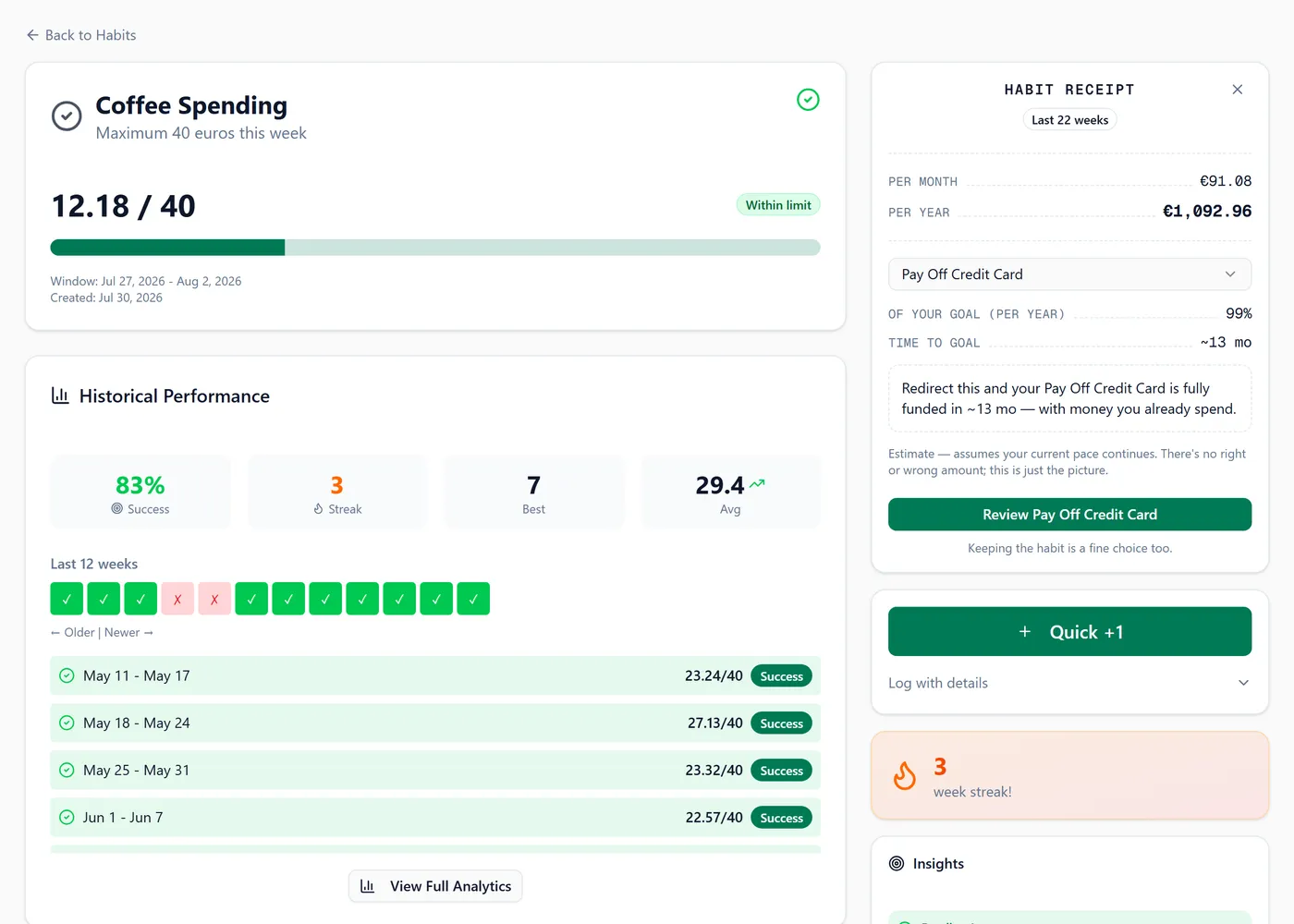
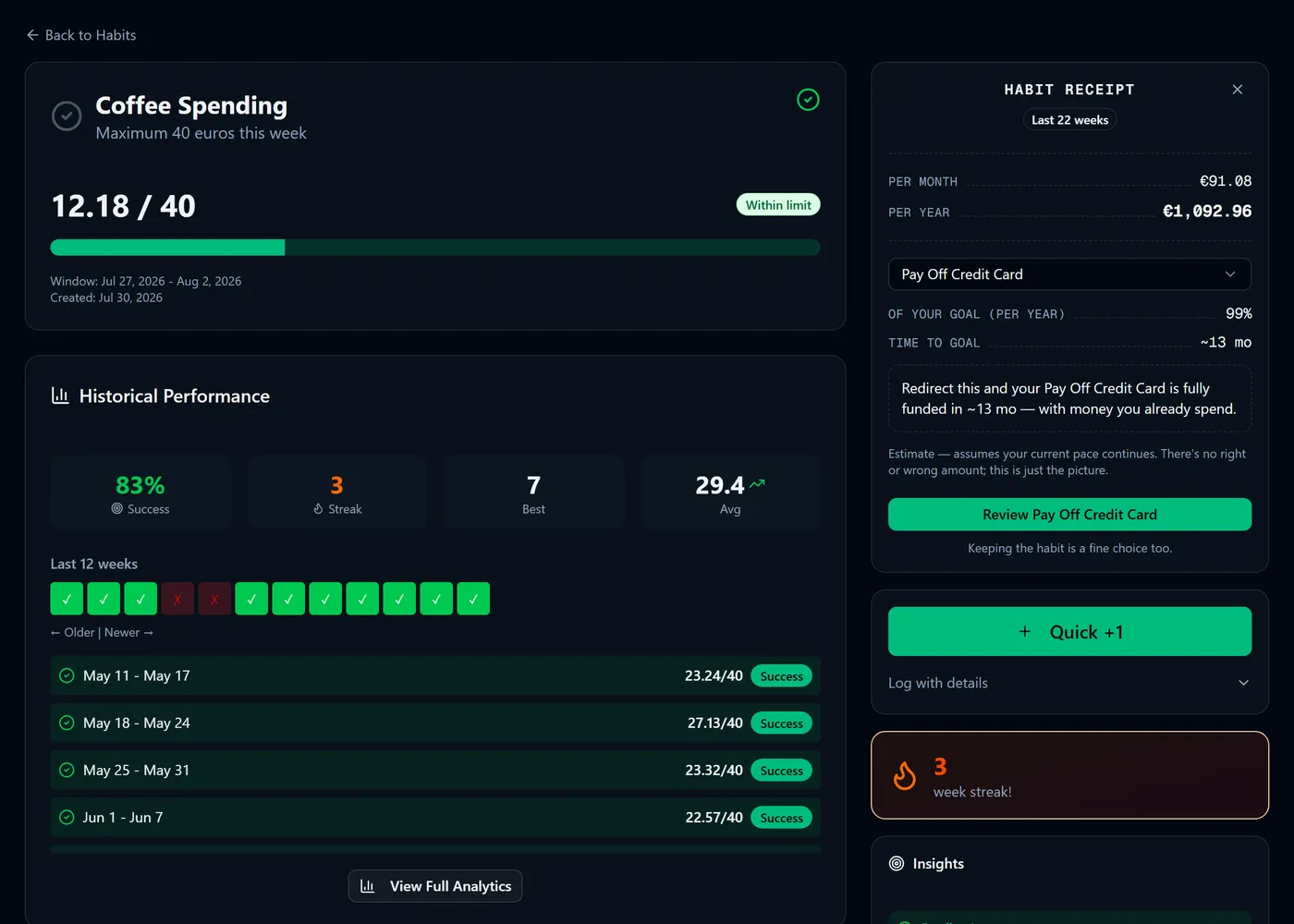
You'll see the receipt appear on the habit page, with a badge saying whether the number is from the last 12 months of real spending or from your estimate.
Tip: if the category also catches spending unrelated to the habit, the number will read high. Either split the category, or use an estimate instead — a clean estimate beats a noisy "actual".
Turn a cost into a goal date
The interesting part is the second half of the receipt. Pick one of your goals and Fyncora shows what would happen if this habit's money went there instead: the new arrival date, and how many months earlier that is.
That's the same projection engine the goals themselves use, so the date on the habit page and the date on the goal page can't disagree.
Try it before committing to anything
The Fyncora home page has a live version of this calculator — pick a habit, set a cost, choose a goal, and watch the receipt. Nothing is saved, and it needs no account.
FAQ
Does logging a habit create a transaction? No. Habit logs and money are separate records; the price tag is a link between a habit and a spending category, not a bookkeeping entry.
Can I price a habit I want to do more of? Yes. A minimum-based habit (exercise, meal prep) can also carry a linked category — for those, the interesting figure is often the spending that drops in weeks you keep the habit.
Is "keeping the habit" always the wrong answer? No, and Fyncora says so on the card. The point is to make the trade visible, not to talk you out of coffee.
Was this helpful?