How the Keep Rate works
Your Keep Rate is the honest version of a savings rate — money set aside for planned spending never counts as saving, so buying the thing you saved for doesn't wreck your numbers.
Updated Jul 30, 2026
On this page
Most money apps compute a savings rate as income minus expenses. That sounds right until you live with it for a year:
You put €400 a month aside for a car. Twelve months later your savings rate looks excellent — then you buy the car, one month shows a €4,800 hole, and the app tells you that you saved nothing this year. Both numbers were wrong. You were never saving €400 a month, and you didn't undo a year of progress in an afternoon.
Fyncora splits every euro you earn into three buckets instead.
The three buckets
Kept is money that grew your wealth — it stayed with you and isn't earmarked for anything in particular.
Parked is money you've deliberately set aside for planned spending: the car, the holiday, the new laptop, next year's insurance bill. It's yours, and it's already spoken for.
Spent is money that left.
Your Keep Rate is Kept ÷ Earned. Parked money is praised, tracked, and celebrated — but it never inflates your Keep Rate, because setting money aside for a purchase isn't the same as getting wealthier.
Why buying the car doesn't hurt
When you finally spend from a parked envelope, two things happen at the same time: money leaves (Spent goes up) and the envelope shrinks by the same amount (Parked goes down). Those cancel out. Your Keep Rate barely moves, because nothing about your wealth actually changed — you converted money you had already earmarked into the thing you earmarked it for.
Tip: this is the whole point of parking money. If a big planned purchase makes your savings rate collapse, the purchase wasn't the problem — the measurement was.
What a negative Keep Rate means
Your Keep Rate can go below zero, and that's a feature. It happens when you spend more than you earned in a period and the money came out of general wealth rather than an envelope — for example, dipping into your emergency fund. That's genuinely different from a planned purchase, and Fyncora refuses to hide it.
Where to find it
- Open Plan → Pay Yourself.
- Pick a period — the default is a rolling three months, which is long enough to survive one unusual month.
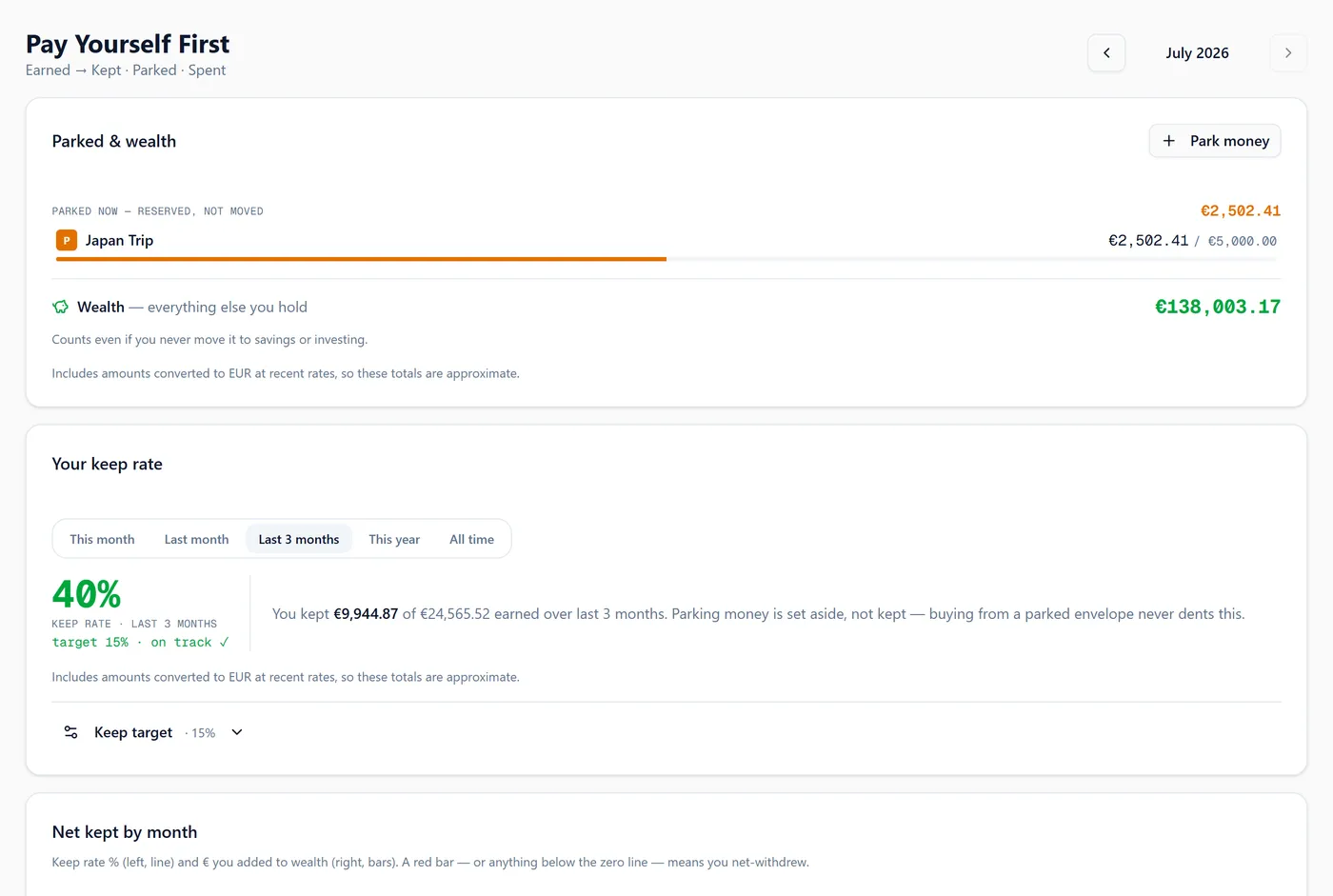
- Read the headline: your Keep Rate, and the Earned / Spent / Kept figures behind it.
You'll see a scoreboard at the top and a month-by-month chart below it. Months where you drew down wealth appear below the zero line, in red.
Note: if you hold accounts in more than one currency, these totals are converted to your base currency at recent rates and labelled as approximate. Individual transactions always keep the currency they were recorded in — see How multi-currency works.
Setting a target
You can set a Keep Rate target (say 15%) from the same page: choose Keep target and pick a percentage. The scoreboard then tells you whether you're on track for the period you're viewing, rather than only what happened.
FAQ
Does a transfer between my own accounts count as saving? No. Moving money from checking to savings changes nothing about what you kept — only earning, spending and earmarking do.
Do I have to move money to a separate account to park it? No, and that's deliberate. Parking is an intention, not a transfer: you can earmark part of the balance sitting in your everyday account. See Park money for planned spending.
Is Kept the same as my net worth? No. Kept is a flow (what a period added), net worth is a stock (what you hold today, including investments and debts).
Was this helpful?