How net worth works
Exactly which accounts count, how investments are valued, and why the number can differ from a simple sum of balances.
Updated Jul 30, 2026
On this page
Net worth is the one number that tries to summarise everything: what you own minus what you owe. Because it touches every account, it's worth knowing precisely what goes into it.
The definition
Net worth is your total assets minus your total liabilities, across accounts that are all of the following:
- active — not archived,
- not hidden, and
- have Include in Net Worth switched on.
Anything failing one of those three is left out entirely.
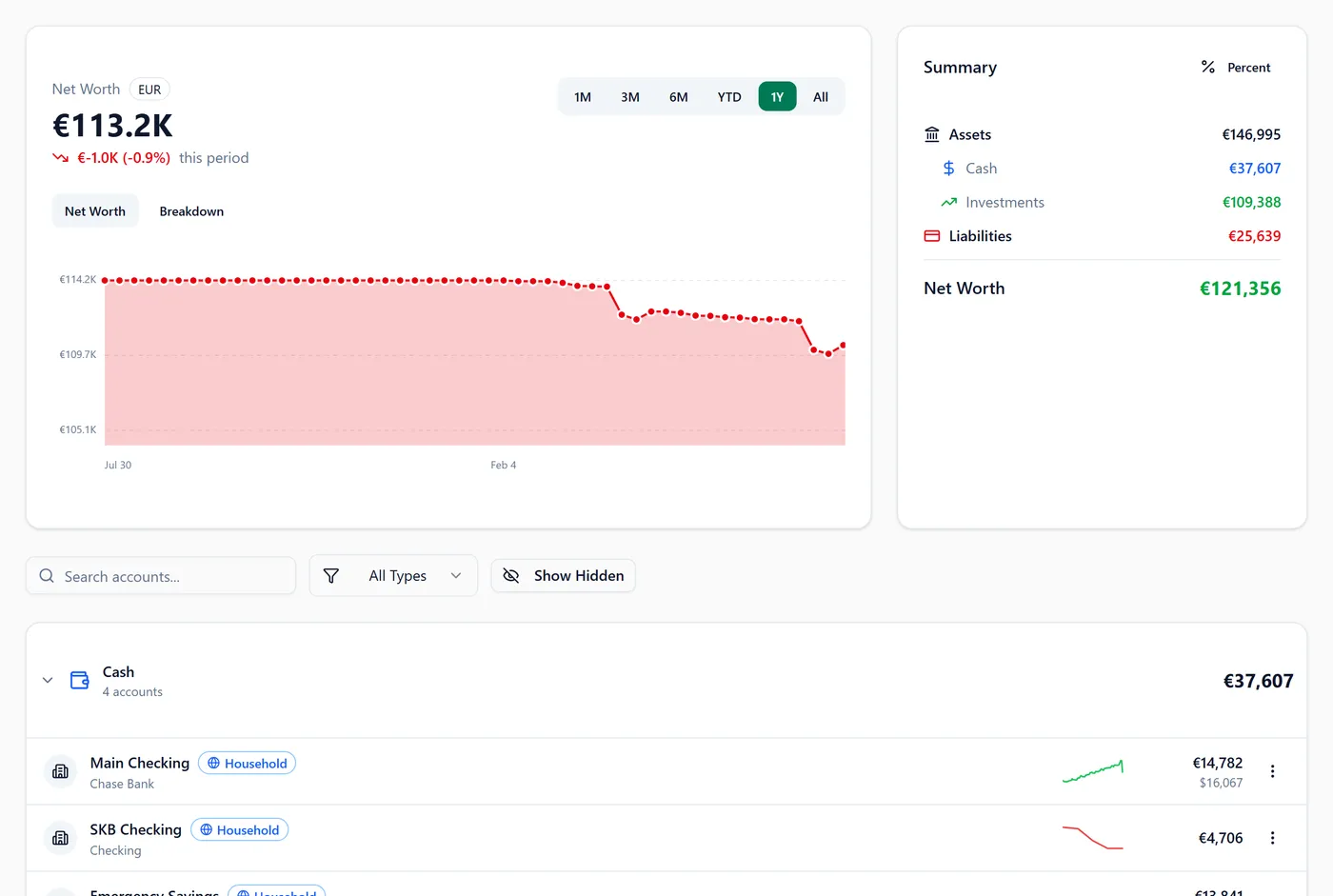
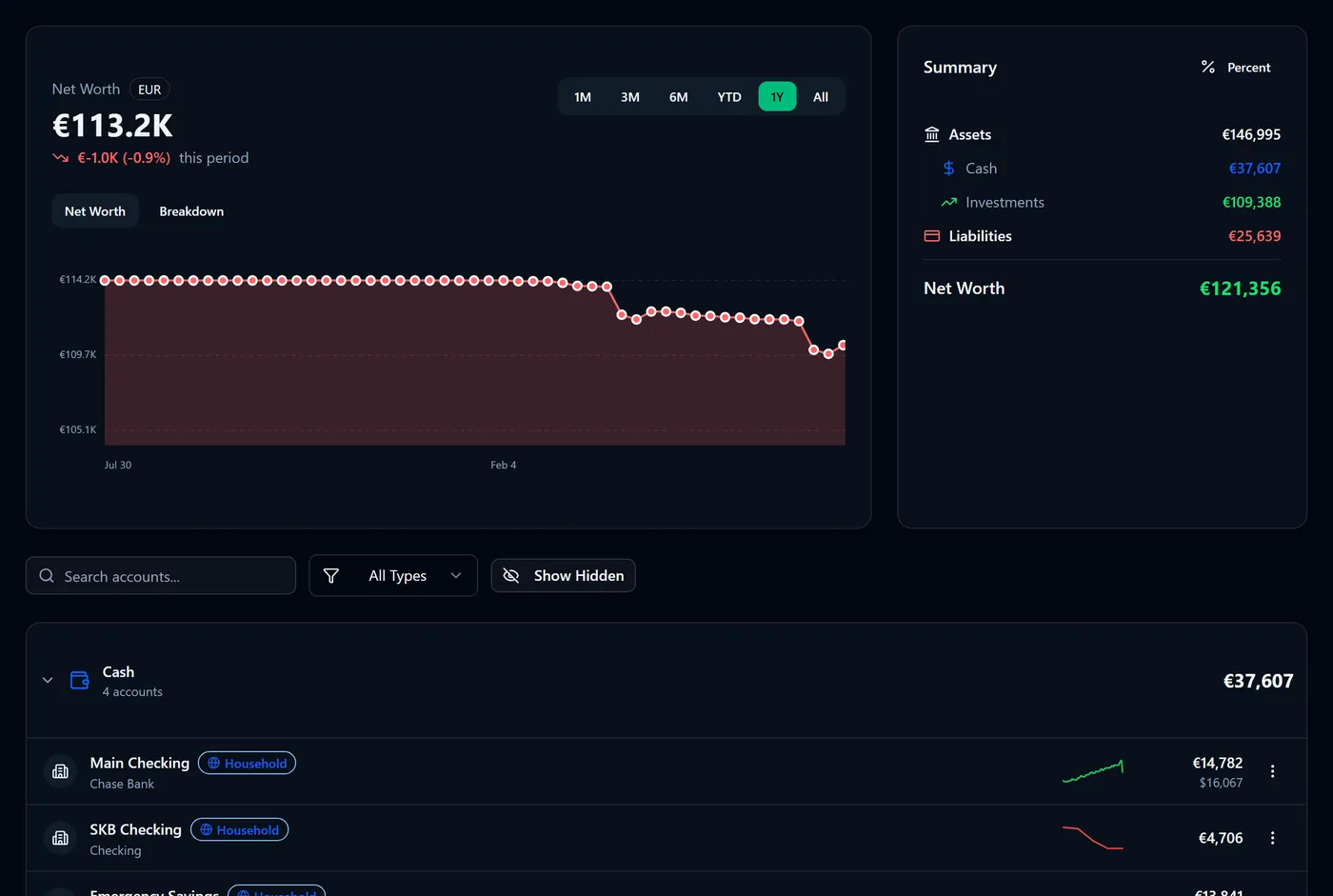
Assets and liabilities are split by type
An account is a liability if its type is Credit Card, Loan, Mortgage or Other Liability. Every other type is an asset.
This split is by type, never by whether the balance is positive or negative, and that has two consequences worth knowing:
- A credit card with a zero balance is not an asset. It's a liability that currently owes nothing.
- An overdrawn current account reduces your assets. It doesn't become a liability — it's an asset with a negative balance, which is what "overdrawn" means.
Liabilities are counted as the amount owed, whichever sign they're stored with.
Note: the Other type counts as an asset. It's read as "some other thing I own", since every kind of debt has its own type.
How investment accounts are valued
An investment account holding securities is valued live, as its cash balance plus the current value of its holdings — not from a stored balance figure that could be out of date.
An investment account with no holdings — one where you simply typed a balance, such as a pension you update by hand — keeps that balance. Your own figure is never replaced by a computed zero.
A holding is converted from its security's own currency, which is often not the currency of the account it sits in.
Tip: if an investment account looks stale, refresh its prices from Investments → Holdings. Net worth reads the holdings' current values, so a price refresh moves the total.
Currency
Every balance is converted to your base currency before anything is added up, using daily reference rates.
If a currency genuinely has no rate available, that balance is excluded from the total and Fyncora tells you so. It is never counted at face value — treating 100 CHF as 100 EUR to make a number look complete would be worse than an incomplete number honestly labelled.
Where to see it
- Accounts — a net-worth summary at the top, then per-group subtotals for Cash, Investments, Liabilities and Other Assets.
- Insights → Reports → Net Worth — the trend over time, with assets and liabilities broken out.
- Home — a summary on your dashboard.
History and snapshots
A snapshot of your net worth is recorded automatically on the first of each month, which is what the trend chart is drawn from. Snapshots record the past — they don't change when you edit an old transaction, because they're a record of what things were at the time.
If the number looks wrong
Work through these in order:
- A hidden account. Select Show Hidden on Accounts to see what's excluded.
- Include in Net Worth switched off on an account — check by editing it.
- An account type filed wrongly — a debt typed as an asset shifts the total by twice its balance.
- A currency with no rate. The total will say it's incomplete, and the affected row shows its own currency instead of a converted one.
- Stale holding prices on an investment account.
FAQ
Does net worth include my goals or budgets? No. It's built from account balances only. Goals track progress towards a target; budgets track spending. Neither adds to or subtracts from net worth.
Why doesn't it match adding up the balances on the Accounts page? Usually because of hidden accounts, an Include in Net Worth toggle, or an investment account valued from its live holdings rather than the balance shown. Liabilities also subtract, so they don't add into the same running total.
Does a household partner's money count? Your personal net worth is built from your own accounts. Household figures are governed by each account's sharing settings — see How account sharing levels work.
Was this helpful?